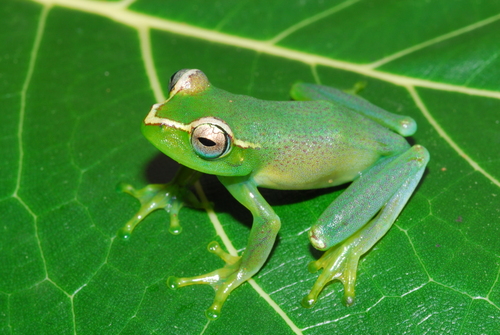
Boophis baetkei
Boophis baetkei is a critically endangered frog species endemic to Madagascar, belonging to the bright-eyed frog family Mantellidae. This arboreal species inhabits the remaining fragments of Madagascar's eastern rainforests, where it depends on pristine forest conditions for survival.
↓Decreasing
Population trend
1
Countries
Photo: (c) joernkoehler, some rights reserved (CC BY-NC)
Taxonomy & Classification
Kingdom
ANIMALIA
Phylum
CHORDATA
Class
AMPHIBIA
Order
ANURA
Family
MANTELLIDAE
Genus
Boophis
Boophis baetkei belongs to the family MANTELLIDAE, order ANURA, within the AMPHIBIA class.
Species Profile
Boophis baetkei is a critically endangered frog species endemic to Madagascar, belonging to the bright-eyed frog family Mantellidae. This arboreal species inhabits the remaining fragments of Madagascar's eastern rainforests, where it depends on pristine forest conditions for survival. Like many Malagasy amphibians, B. baetkei has evolved in isolation on the island, developing unique characteristics that distinguish it from its relatives. The species faces severe threats from Madagascar's ongoing deforestation crisis, which has eliminated vast areas of its natural habitat for agriculture, logging, and human settlement. Climate change poses additional challenges by altering the temperature and humidity conditions essential for amphibian survival and reproduction. The species' restricted range makes it particularly vulnerable to habitat loss, as populations have little opportunity to relocate when their forest homes are destroyed. Madagascar's amphibians are among the world's most threatened vertebrate groups, with many species experiencing rapid population declines. Conservation efforts for B. baetkei include habitat protection initiatives within Madagascar's national park system and research programs aimed at better understanding the species' ecology and breeding requirements. International conservation organizations work alongside Malagasy institutions to develop strategies for preserving remaining forest fragments and establishing corridors between protected areas. However, the ongoing socioeconomic challenges in Madagascar continue to drive habitat destruction, making the long-term survival of this species uncertain without sustained conservation intervention.
Boophis baetkei faces primary threats from deforestation and habitat fragmentation as Madagascar's eastern rainforests are cleared for agriculture and human settlement. Climate change compounds these pressures by altering the temperature and humidity conditions this forest-dependent amphibian requires for survival.
Key Facts
Habitat & Distribution
This species inhabits the eastern rainforests of Madagascar, living in the forest canopy where it depends on the stable temperature and humidity conditions of intact primary forest. The species requires pristine forest environments with minimal human disturbance.
Threats
IUCN Red List: Critically Endangered
Boophis baetkei faces primary threats from deforestation and habitat fragmentation as Madagascar's eastern rainforests are cleared for agriculture and human settlement. Climate change compounds these pressures by altering the temperature and humidity conditions this forest-dependent amphibian requires for survival.
Annual & perennial non-timber crops
Livestock farming & ranching
Logging & wood harvesting
Mining & quarrying
Conservation Actions
Found in 1 Country
Community Sightings
Report a sightingNo community sightings yet. Be the first to report!
Sources & Attribution
Data sourced from the IUCN Red List of Threatened Species. AI-enriched profiles generated by SpeciesRadar.